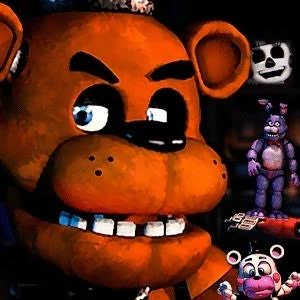
 Fnaf 1
FNAF 1 Unblocked refers to browser-based versions of Five Nights at Freddy's that run on school or work networks where many gaming sites are typically restricted. The game puts you in a security office, watching cameras and managing doors to survive five nights against animatronic characters, without needing a download or installation.
Five Nights at Freddy's turned a simple premise into one of the most talked-about horror games of the last decade. A pizza restaurant, a night shift, and four animatronic characters that don't stay where they're supposed to. That's the whole pitch, and somehow it's enough to keep players checking hallway cameras with their hearts pounding.
Five Nights at Freddy's is a point-and-click survival horror game created by Scott Cawthon. You play as a night security guard stationed alone inside Freddy Fazbear's Pizza, a family-friendly restaurant whose animatronic performers act very differently once the lights go down and the customers go home.
During the day, the restaurant is exactly what it sounds like: cheerful, musical, full of kids' birthday parties. At night, something shifts. The animatronics, Freddy, Bonnie, Chica, and Foxy, begin moving through the building on their own, and your job is to make sure none of them reach your office before your shift ends at 6 AM.
The setting does a lot of the work here. A family restaurant should feel safe. Turning that same space into a source of dread, just by changing the lighting and removing the staff, is part of what made the original game stand out when it first released.
Unlike most horror games, Five Nights at Freddy's doesn't let you run, fight, or explore. You're confined to a single office, and your only tools are a bank of security cameras, two hallway doors, and a limited power supply. That restriction is the entire game.
You're stuck in the security office for the whole shift. There's no walking down hallways or investigating noises yourself. Instead, you rely on a wall-mounted monitor that cycles through security cameras placed around the restaurant, giving you a partial, often unsettling view of where each animatronic currently is.
This limitation is intentional. It turns the game into a management puzzle rather than a typical chase sequence. You're not avoiding danger by outrunning it. You're avoiding danger by predicting it before it arrives.
Checking cameras tells you where the animatronics are, but it doesn't protect you directly. The real defense comes from the two doors on either side of your office, along with the lights that illuminate the blind spots just outside each doorway.
When a character gets close, your job is to check the hallway light, confirm the threat, and seal the appropriate door before they reach you. Wait too long and you won't get a second chance. Close the door too early, too often, and you'll burn through a resource you can't get back.
Every action, cameras, lights, and doors, pulls from the same limited power supply. This is the detail that transforms the game from a reflex test into a strategic one. You can't just hold both doors shut all night and call it safe. The power will run out long before 6 AM, and once it does, the office goes dark with no doors, no lights, and no cameras to warn you.
That shared power meter forces constant trade-offs. Do you check the cameras one more time, or save the charge in case you need to slam a door in the next ten seconds? There's no universally correct answer. The right call depends on what night you're on and which animatronic is closest.
Freddy, Bonnie, Chica, and Foxy each follow their own movement patterns and timing. Early nights are built to teach the fundamentals: how to check cameras efficiently, when to trust a door closure, and how to pace your power usage. Later nights raise the stakes considerably, demanding faster camera checks, sharper listening for audio cues, and tighter power discipline.
This escalation is why the game rewards repetition. The first night might feel almost too quiet. By the fifth, you're juggling multiple threats with a power meter dropping faster than you'd like. That rising pressure, layered on top of genuinely simple controls, is a big part of why Five Nights at Freddy's has stuck around in gaming conversations for years after its release.
If you're playing for the first time, resist the urge to treat every sound as an emergency. Early nights are designed to be survivable with basic habits: check your cameras on a steady rotation, glance at both hallway lights periodically, and only close a door when you've confirmed a threat is actually near.
Power conservation matters from night one, even though it won't feel urgent at first. Building the habit of using lights and doors only when necessary will make the later, tougher nights far more manageable. Players who burn through power recklessly early on tend to struggle once the pace picks up.
Five Nights at Freddy's earns its reputation through restraint rather than spectacle. There's no elaborate combat system, no open world to explore, just a locked office, a dwindling power supply, and four characters that know the building better than you do. That simplicity is exactly what makes each night feel tense in a way that's hard to replicate.
The original game features four main animatronics: Freddy Fazbear, Bonnie, Chica, and Foxy, along with a mysterious fifth character revealed later in the game.
The game contains jump scares and unsettling themes, so it's generally recommended for teens and older rather than young children.
While each game can technically be played independently, the overarching story and lore make more sense when played in release order, starting with FNAF 1.
It's available on PC, iOS, Android, and multiple gaming consoles.
Yes, surviving all five nights (and an optional harder sixth night) completes the main game, though a full understanding of the story often requires piecing together hidden lore and easter eggs.